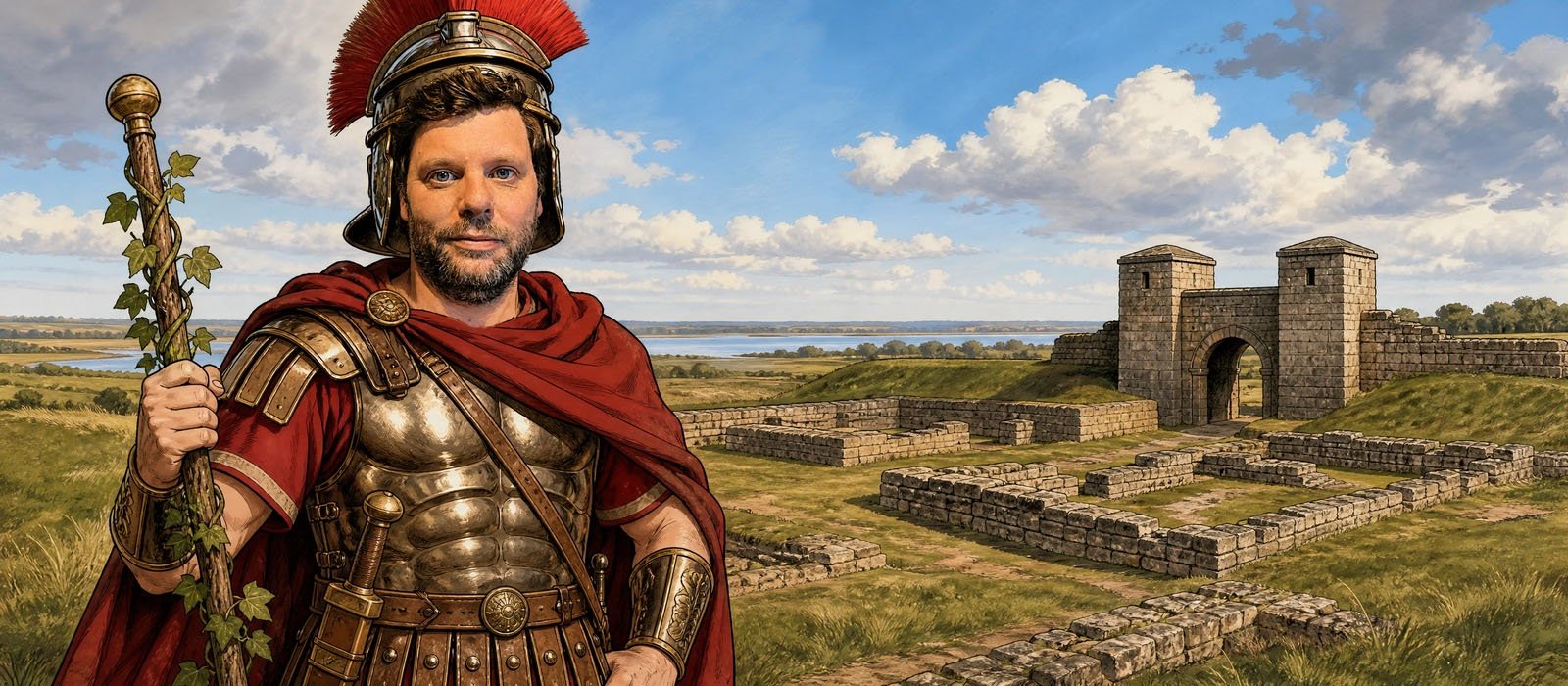
Prologue: A Beach With Main Character Energy
Long before it became a lumpy field of foundations two miles from the sea, Richborough (Rutupiae, to give it its posh Latin name) was a small island in the Wantsum Channel, a strip of water separating the Isle of Thanet from the rest of Kent. It had good landing beaches, sheltered water, and absolutely no idea what was about to happen to it.
In AD 43, that changed, because the Emperor Claudius needed a win.
Claudius had come to power in the most Roman way possible — by being found hiding behind a curtain after his nephew Caligula was assassinated — and he desperately needed to prove he wasn’t just an accident of palace politics who stammered and limped his way onto the throne. Conquering a mysterious island at the edge of the known world seemed like exactly the kind of thing that would shut the Senate up.
So he sent Aulus Plautius and roughly 40,000 men across the Channel. Most historians agree they landed at or near Richborough. Nobody agrees on much else, which has never stopped anyone from being extremely confident about it.
Aulus Plautius, disembarking, probably:
“Right. We’ve been at sea for what feels like several apocalypses, half the men refused to get on the boats because they’d heard Britain was ‘literally past the edge of the world,’ and Emperor Nutcase back home wants a triumph. Somebody find me some Britons to conquer before lunch.”
The invasion force reportedly had genuine trouble getting the troops to board the ships in Gaul in the first place — the soldiers apparently believed they were being asked to sail off the edge of the known universe, which is a very reasonable thing to be upset about. Legend holds it took a pep talk from Claudius’s freedman Narcissus to get them moving, an event so undignified that the soldiers began jokingly chanting his name, presumably somewhere between mockery and Stockholm syndrome.
A legionary, possibly, to another legionary:
“We just got emotionally manipulated onto these boats by the Emperor’s PA. This is rock bottom. Also I think that’s land. Never mind, rock bottom postponed.”
Chapter One: The World’s Most Overbuilt Welcome Mat
Once ashore, the Romans did what Romans always did: they immediately started digging enormous defensive ditches, because nothing says “we come in peace” quite like fortifying your beachhead within the hour. Archaeologists have found the remains of these earliest ditches — two of them, forming a defended supply base — right at the base of the peninsula.
Aulus Plautius, surveying the beach, allegedly, once the ditches were dug:
“Right, we’ve conquered the beach. I’m calling this a win and someone else can deal with the actual island.”
The local Britons, watching several thousand men in metal skirts squelch ashore and start trenching, were reportedly less impressed than eighteen centuries of triumphant Roman historiography would have you believe. One unnamed chieftain, watching from a safe distance, is imagined to have muttered:
“Wonderful. They’ve brought us roads, taxes, and togas. We had a perfectly good system of just hitting each other with sticks.”
Richborough’s genius, from a Roman logistics standpoint, was that it was the closest safe harbour to Gaul. This made it the obvious spot to become the official front door of Roman Britain: the place where soldiers, officials, merchants, gladiators (probably), and an unknowable quantity of Gaulish wine all arrived before heading inland to wherever the actual conquering needed doing.
A quartermaster’s ledger, entirely invented but spiritually accurate:
“Received this week: 600 amphorae of wine, 40 barrels of garum (a fermented fish sauce the men insist on putting on everything), one crate of good olive oil, and one (1) British sheep that wandered in and that nobody has the heart to send back.”
For the next few decades, Richborough functioned less like a battle-hardened frontier fort and more like Britain’s first, and possibly worst, international airport — minus the duty-free, plus significantly more mud.
Chapter Two: The Arch of Excessive Confidence
By around AD 85, Rome had decided Britain was basically sorted (this would prove to be spectacular overconfidence, given the empire would spend the next several centuries fighting people in what is now Scotland). To mark the occasion, they built something spectacular at Richborough: a colossal four-way triumphal arch, faced in imported Italian marble, roughly 25 metres tall, visible from ships far out at sea.
This was not a subtle monument. It was, essentially, Rome erecting an enormous marble billboard reading “WE DID IT” at the exact spot where every nervous new arrival first set foot on the island, so that the very first thing anyone saw of Britain was a gigantic advertisement for how thoroughly it had already been conquered.
A merchant arriving from Gaul, probably, squinting up at it:
“That is a lot of marble for what I was told is a swamp with occasional sheep. I respect the commitment to the bit.”
A junior officer stationed there, definitely:
“I have been assigned to guard an enormous stone advertisement for a war that finished before I was born. My father fought real Britons. I fight pigeons that have taken up residence in the archway.”
A passing sailor, unbothered, to nobody in particular:
“Lovely arch. Bit much for a fort that mostly processes paperwork and pickled fish, but lovely.”
The arch stood for well over a century, gleaming, ludicrous, and magnificent, doing essentially nothing except reminding everybody who sailed past exactly how impressed they were supposed to be.
Chapter Three: Everything Goes Wrong, Extremely Slowly
By the third century AD, Rome’s grip on Britain had gone from “smug marble arch” to “increasingly nervous about raiders,” specifically Saxon pirates who had developed the rude habit of showing up uninvited and taking things that weren’t theirs.
Around this same period, a rogue Roman admiral named Carausius decided that rather than fighting for Rome, he’d simply declare himself emperor of Britain and northern Gaul instead, which is the sort of career pivot modern LinkedIn influencers can only dream of. Richborough sat right in the middle of this chaos.
Carausius, probably, upon declaring himself emperor:
“New job title, same commute. Difference is now nobody can fire me, they can only violently overthrow me, which is a nice change of pace.”
By the 270s, the magnificent arch — that once-glorious symbol of total victory — was unceremoniously demolished, its foundations buried under a defensive earthwork. Rome, it turned out, no longer had the luxury of decorative marble optimism; it needed a proper fort, with proper walls, because the raiders kept raiding.
A Roman engineer, surveying the rubble of the demolished arch:
“Bad news: we’re tearing down the giant marble monument to our own greatness. Good news: we’re using the rubble as core fill for a wall that will actually stop people from stabbing us. On balance, I call this progress.”
What emerged was one of the “Saxon Shore forts” — a chain of coastal strongholds built to defend Britain’s southeastern coast, with Richborough’s new walls reaching an imposing 8 metres high and 3 metres thick, still standing today and still, frankly, showing off.
A Saxon raider, looking up at the new walls from a boat, allegedly:
“Right, change of plans, let’s go raid literally anywhere else.”
A weary garrison commander, filing a supply request around this time, probably:
“Requesting reinforcements. Also requesting someone explain why we spent nearly 190 years admiring an arch instead of building a wall.”
Chapter Four: The Long, Slow, Slightly Undignified Retirement
Rome’s hold on Britain finally crumbled in the early 5th century. The famous, possibly apocryphal story goes that the Britons wrote to the Roman authorities begging for military help against raiders, and were essentially told to sort it out themselves — a message historians call the “Rescript of Honorius” and which Britons at the time almost certainly called several ruder things.
The Emperor Honorius, allegedly, via official memo:
“Dear Britain, thoughts and prayers. Please defend yourselves. Sincerely, Rome, who is currently dealing with several other empires’ worth of problems and simply does not have the bandwidth for you right now.”
Richborough’s garrison packed up, and the fort that had once been the grandest gateway into an empire slowly became just a large, quiet pile of very good masonry. Over the following centuries, the Wantsum Channel — the very waterway that had made Richborough such a brilliant strategic landing spot — gradually silted up and vanished entirely, leaving the once-coastal fort stranded roughly two miles inland, like a lighthouse keeper who fell asleep and woke up in a farmer’s field.
The last Roman officer at Richborough, leaving, entirely fabricated but emotionally true:
“So. That’s the arch gone, the empire gone, and apparently the sea is also planning to leave eventually. Everybody’s just walking out on this place. Lock the gate anyway, out of principle.”
He is further alleged, sighing, halfway down the road, to have added:
“Right, that’s Britain done. Someone tell Rome it rains here. A lot.”
Epilogue: A Field That Used to Be Extremely Important
Today, Richborough is managed by English Heritage — a peaceful, grassy site of tumbled walls and foundation trenches where visitors can examine the outline of the great arch’s base, the Saxon Shore walls, and an amphitheatre nearby, all while standing on ground that was once, briefly and extravagantly, the single most important doorway in the entire Roman Empire’s newest province.
Nothing at the site today shouts about this nearly as loudly as the arch once did. Which feels, in its own way, like the most Roman ending imaginable: a place that spent 400 years being either enormously overbuilt or enormously undersupplied, and is now enjoying a very long, very quiet retirement.
A modern tour guide, probably, wrapping up:
“And that concludes our tour of the beach that conquered an island, the arch nobody needed, and the sea that got bored and left. Gift shop’s this way. They do sell little plastic legionaries, if that helps.”
Note: the historical framework here — the AD 43 landing, the reluctant troops, the Claudian triumph, the great marble arch, Carausius’s usurpation, the Saxon Shore fort walls, and the eventual silting of the Wantsum Channel — reflects the real archaeological and historical record. The quotations, however, are entirely invented for comic effect and were not said by anyone, ever, probably.
