Prologue: A Fishing Village With Ambitions
For centuries, Folkestone was a modest fishing settlement getting quietly battered by shingle and storms at East Wear Bay, doing the traditional English seaside thing of catching fish and complaining about the weather. Then, in the early 19th century, Lord Radnor decided the town deserved a proper stone harbour, and brought in two of the biggest names in engineering — William Jessop and Thomas Telford — to design it.
A local fisherman, watching two of the most famous engineers in Britain arrive to fix his harbour, probably:
“We asked for a wall to stop the boats getting smashed up. They’ve sent the men who built the Menai Bridge. Feels a bit like asking for a rowing boat and being handed an ocean liner.”
Chapter One: Bankruptcy, As Is Traditional
The original Folkestone Harbour Company built the thing, ran out of money almost immediately, and was declared bankrupt in 1842 — a fate so common among 19th-century British infrastructure projects it may as well have been included in the original planning permission. The harbour sat there, derelict and unloved, until the South Eastern Railway Company bought it up, smelling an opportunity to steal Dover’s cross-Channel business right out from under it.
A South Eastern Railway director, inspecting the bankrupt harbour, imagined:
“It’s derelict, it’s half-finished, and its previous owners went spectacularly broke building it. Perfect. Buy it. We shall make Dover extremely nervous.”
The railway reached Folkestone in 1843, a branch line was laid down the steep slope to the harbour itself, and by 1st January 1849 the world’s first proper international rail-sea-rail timetabled service was running: London to Paris via Folkestone and Boulogne, in a briskly efficient twelve and a half hours — sea crossing included. This was, at the time, roughly equivalent to teleportation.
A Victorian passenger, boarding for Paris, allegedly:
“Twelve and a half hours to Paris, including the sea. My grandfather once took three days to get to the next county over and considered it a great adventure. We live in an age of miracles, and also mild seasickness.”
That same month, the world’s first ever telegraphed conversation took place between a man aboard a Channel boat and the Chairman of the South Eastern Railway sitting comfortably in his London office, proving that even in 1849 people could not resist the urge to phone the boss the second new technology allowed it.
The Chairman, receiving the world’s first-ever telegraph message from a boat, imagined:
“A message. From a man. At sea. Arriving instantly. This changes everything. … Yes, tell him the quarterly figures are fine, he needn’t have gone to all this trouble.”
Six years later, in 1855, the harbour also hosted the famously audacious “Great Gold Robbery,” in which thieves swapped gold bullion bound for Paris with plain lead shot somewhere en route — a crime so smooth nobody even noticed until the boxes were weighed on arrival in France.
A Parisian customs official, weighing the boxes, imagined:
“These are meant to be full of gold. They are full of lead. Someone, somewhere between London and here, has performed an extraordinary piece of theatre, and frankly I’d like to shake their hand before I have them arrested.”
Chapter Two: Folkestone Becomes Extremely Fashionable
With the railway pumping in tourists and cross-Channel travellers, Folkestone bloomed over the following decades into one of England’s most fashionable resort towns, all promenades and parasols and people pretending they weren’t just there to catch the boat to Boulogne. By 1900 around 200,000 passengers a year passed through the harbour; by 1911 that had swollen to half a million.
The Harbour Arm itself — the great pier stretching out into the Channel, eventually topped with its own lighthouse — was extended and rebuilt in stages over decades, finally completed in 1904, allowing bigger boats to dock in deeper water without the indignity of getting stuck on a sandbank in front of fashionable Edwardian society.
A dockworker, watching the extended pier open, imagined:
“Right, so now the boats can dock in deep water like dignified adults, instead of getting embarrassingly beached in front of everyone in their Sunday best. Progress.”
Chapter Three: The Gateway to the Trenches
Then came 1914, and Folkestone’s cheerful holiday-and-boat-trains operation was transformed, almost overnight, into one of the single most important military transit points in the entire war. So many soldiers departed from Folkestone Harbour bound for the Western Front that it earned the grim nickname “the Gateway to the Trenches.” Over the course of the war, an almost incomprehensible number of people passed through: more than 9.25 million British officers and men, over half a million allied troops, and close to 850,000 Red Cross and other workers, alongside more than a million tonnes of freight.
A harbour porter, watching yet another endless line of soldiers file past, imagined:
“I used to help fashionable ladies with their hatboxes onto the Paris boat. Now I am helping several hundred thousand young men onto boats bound for a war. Same harbour. Extremely different energy.”
The harbour ran a free buffet — the “Mole Café” — dishing out tea and refreshments to the endless procession of soldiers, sailors, and Red Cross workers, in what must rank as one of history’s more heartbreaking hospitality operations: unlimited tea, served to men who mostly weren’t coming back.
A volunteer at the Mole Café, pouring tea for the ten-thousandth soldier that month, imagined:
“Sugar? Milk? Try to come back safely? I say all three things to every single man who passes this counter, and I have started to lose track of which one I actually mean the most.”
Commercial shipping continued, but under heavy military control, and the harbour was fortified against enemy attack — including the rather dramatic step of deliberately scuttling a tramp steamer across the Harbour Arm to physically block enemy vessels from landing. One requisitioned ship, the hospital ship HMHS Anglia, struck a German mine just a mile off the coast in November 1915, with the loss of 134 lives — a sober reminder that even a harbour dedicated to healing wasn’t safe from the war it was trying to help end.
Chapter Four: An Encore Nobody Wanted
Barely two decades later, Folkestone Harbour found itself once again a frontline piece of infrastructure. During the Dunkirk evacuation of 1940, every boat in the harbour was pressed into service, and over a frantic nine-day period an estimated 35,000 troops and 9,000 refugees were landed at Folkestone, filling 64 trains bound for London and beyond.
A stationmaster, watching train number sixty-something pull out, imagined:
“Twenty-five years ago I watched this station send young men to France by the boatload. Now I’m watching it receive them back by the boatload, exhausted, in whatever boats we could find. I would very much like this station to have one calm decade at some point in my lifetime.”
The harbour, unsurprisingly, also became a target for German air raids for the remainder of the war — the price of being the closest useful piece of English coastline to occupied Europe.
Chapter Five: A Long, Slow, Dignified Wind-Down
After 1945, the harbour picked itself back up. Cargo services resumed, ferries returned to Calais and Belgium, car-carrying services began in 1946, and by 1960 the port was carrying over 800,000 passengers, hundreds of cars, and hundreds of lorries a year. In the early 1970s, a roll-on/roll-off ramp was even built for two new ferries, cheerfully named Hengist and Horsa after the legendary Anglo-Saxon brothers who supposedly invaded Britain in the 5th century — a slightly ominous choice of name for vessels whose entire job was ferrying people peacefully back and forth.
A ferry marketing executive, naming the new boats, imagined:
“Let’s name our friendly car ferries after the two legendary warlords who led an Anglo-Saxon invasion of Britain. Nothing says ‘pleasant day trip to France’ quite like a pair of vessels named for a violent 5th-century conquest.”
Then, in 1994, the Channel Tunnel opened, and Folkestone’s centuries-old business model — being the shortest, most convenient way to physically get a boat between England and France — quietly evaporated overnight. A high-speed catamaran limped on through the 1990s, but by 2000 the last ferry link had closed for good, and by 2001 all cross-Channel sailings from Folkestone had ended entirely.
A ferry company executive, reading the Channel Tunnel opening announcement in 1994, imagined:
“So there’s now a tunnel. Under the sea. That people can simply drive through. In about half the time. Without getting wet. Without getting seasick. Without needing a boat at all. … I would like to lodge a complaint with the concept of progress.”
The harbour, its station, and its railway line settled into a long and increasingly derelict retirement — mothballed, fenced off, and largely forgotten, its once-grand station reduced to a rusting curiosity, and its fishing fleet dwindling to just ten boats by 2002.
A local resident, walking past the padlocked, weed-choked harbour station sometime in the early 2000s, imagined:
“This building sent nine million men to war and once ran its own fashionable boat train to Paris. It is now home to pigeons and a suspicious amount of buddleia. I don’t know what to do with that information, but I feel it deeply.”
Epilogue: From Gateway to the Trenches to Gateway to Brunch
In 2004, Sir Roger De Haan — former chairman of Saga, and a man apparently unable to look at a derelict Victorian harbour without wanting to fix it — bought the whole site for £11 million. Over the following two decades, the Folkestone Harbour and Seafront Development Company painstakingly restored the harbour station, the viaduct, the signal box, and the Harbour Arm itself, transforming a rusting, padlocked relic of imperial transit infrastructure into rather the opposite: a promenade of bars, street food stalls, a giant outdoor screen, and a lighthouse you can get a cocktail next to.
The ghost of a young soldier, hypothetically wandering the restored Harbour Arm today, imagined:
“I distinctly remember departing from this exact spot in 1917 to fight in a World War. There is now a man selling me something called a ‘loaded fry’ from a converted shipping container. I do not know what to make of any of this, but the smell is extraordinary and I am staying.”
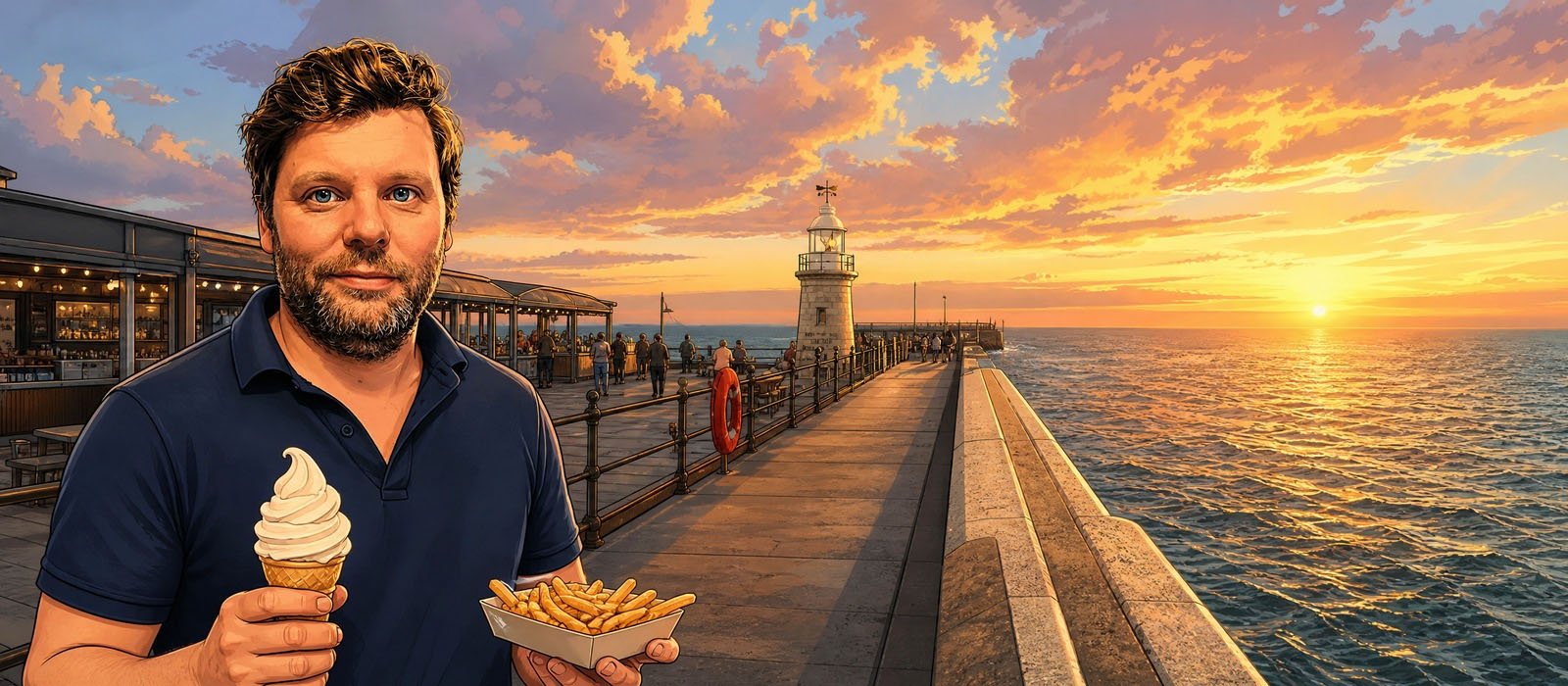
Today, the same stretch of pier that once processed nine million departing soldiers, launched its own fashionable boat train to Paris, and briefly hosted a gold heist now processes ice creams, sunset drinks, and a great many people taking photographs of the lighthouse. It is, on balance, an improvement.
A modern-day visitor, strolling the Harbour Arm at sunset, probably:
“Lovely spot. Nice lighthouse. Great chips. Did you know nine million soldiers left for the trenches from roughly where I’m standing with this ice cream? … No, I didn’t either, until that plaque. Anyway. Chips are excellent.”
Note: the historical framework here — Lord Radnor’s original harbour, the South Eastern Railway’s 1843 takeover, the 1849 rail-sea-rail service, the Harbour Arm’s completion in 1904, the harbour’s central role in both World Wars (the “Gateway to the Trenches” and the Dunkirk evacuation), the post-war ferry decline following the Channel Tunnel’s 1994 opening, the ferry closure by 2001, and Sir Roger De Haan’s 2004 purchase and subsequent regeneration — reflects the real historical record. The quotations, however, are entirely invented for comic effect and were not said by anyone, ever, probably.
